how-to
How Do You Verify Authentic Beauty Tech Devices?
Last Updated: November 4, 2026
Quick Summary
To verify authentic beauty tech, check the packaging, build quality and serial number against the brand's own verification tool before you buy. Confirm the seller appears on the brand's authorized retailers list, and save a screenshot of the serial number result with your receipt.
- Compare the batch code on the box with the one on the device; they should match.
- Enter the serial number on the brand's official website, not a link from a seller.
- Ask the seller for proof of authorization in writing before you buy.
- Stop using a suspected counterfeit, photograph everything, and contact the seller in writing.
- Contact your card issuer before the chargeback window closes if the seller refuses a refund.
Table of Contents
- Why Verification Comes Before Every Beauty Tech Purchase
- The Real Risks of Non-Authentic Beauty Technology
- How to Spot Fake Beauty Gadgets: A Step-by-Step Inspection
- Running an Official Beauty Device Serial Number Check
- Building Your Authorized Beauty Tech Retailers List
- What to Do If You Suspect You Bought a Counterfeit Device
- Frequently Asked Questions
Why Verification Comes Before Every Beauty Tech Purchase
Learning how to verify authentic beauty tech devices starts with one habit: check before you buy.
That gap matters. A fake device can overheat, deliver uneven energy, or carry bacteria from cheap materials. None of that shows up in a product photo.
This guide walks through the full check, from the box to the serial number to the retailer.
The stakes are higher than most shoppers expect. A counterfeit device has no warranty, no service support, and no paper trail if something goes wrong.
The Real Risks of Non-Authentic Beauty Technology
Fake beauty tech is not a harmless bargain. The risks of non-authentic beauty technology fall into two groups: electrical danger and skin danger. Both are serious, and both are hard to spot from the outside. Most guides stop at "it might overheat." This section goes deeper, because the difference between a real and fake device often lives in the circuitry you cannot see.
Electrical and Electromagnetic Hazards
Counterfeit devices often use cheap internal parts with no safety testing.
CE marking on a product generally indicates it has been assessed against European directives for electrical safety and electromagnetic compatibility. FCC certification serves a similar role in the United States.
A common pattern with fakes is undersized or missing internal components: no thermal fuse, no proper grounding, and no electromagnetic shielding.
Watch out: a device that warms up far faster than the instructions describe, or that causes a tingling sensation when touched, is a red flag.
Skin Safety and Contamination
Skin safety depends on materials and clean surfaces. Counterfeit tools often use unlisted plastics and metals that can irritate skin. Shared or poorly sealed parts can also trap bacteria.
A useful check is to compare the device's contact surfaces against the brand's published material list.
For deeper guidance on devices built for melanin-rich skin, see the guide to the best beauty tech for dark skin tones. It covers the safety checks that matter most.
How to Spot Fake Beauty Gadgets: A Step-by-Step Inspection
Spotting a fake takes about ten minutes at the counter or on delivery day. Work through the checks below in order. Each one is quick, and each one catches a different kind of fake.
Packaging, Labels, and Documentation Checks
Start with the box. Real packaging has sharp printing, even colors, and a tamper-evident seal that is intact. Check these points:
- Logo alignment: the logo should sit straight and match the brand's official look.
- Spelling: read every label. Fakes often carry small typos or odd phrasing.
- Fill levels: for creams or gels sold with a device, the fill should match the stated volume.
- Instruction manual quality: a real manual is printed clearly, in full sentences, with a support contact.
- Discolored packaging: faded or patchy ink suggests a cheap reprint.
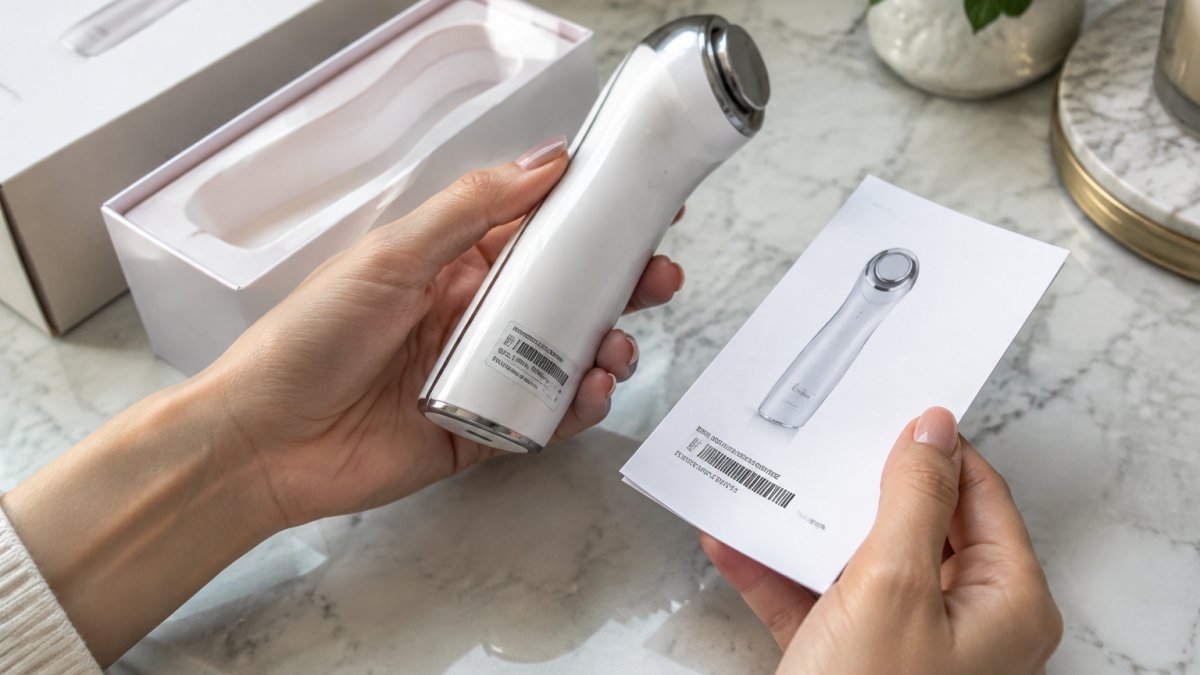
Compare the batch code on the box with the one on the device itself. They should match.
Weight, Build Quality, and Hardware Inspection
Pick the device up. Real beauty tech has heft and clean seams. Fakes feel light and hollow.
Run a hardware inspection:
- Check the seams for gaps or glue marks.
- Press every button. Each should click firmly.
- Look at the charging port for a loose or crooked fit.
- Confirm the voltage on the label matches your local supply.
- Feel the surface. Rough edges or a chemical smell are warning signs.
A price discrepancy is the last clue. If a device sells far below the usual retail level, treat that as a question, not a deal.
Work through these quick checks in order to catch different kinds of fakes.
| Check | What to look for | Warning sign |
|---|---|---|
| Logo alignment | Logo sits straight, matches official look | Crooked or mismatched logo |
| Spelling | Every label reads correctly | Small typos or odd phrasing |
| Fill levels | Fill matches stated volume | Fill does not match stated volume |
| Instruction manual | Printed clearly, full sentences, support contact | Poor print or missing support contact |
| Packaging color | Even colors, intact tamper-evident seal | Faded or patchy ink |
| Batch code | Box code matches device code | Codes do not match |
| Weight and seams | Heft, clean seams, firm button clicks | Light, hollow, gaps or glue marks |
| Price | Near usual retail level | Far below usual retail level |
Running an Official Beauty Device Serial Number Check
An official beauty device serial number check is the fastest way to confirm a device is real. Every genuine unit carries a unique serial number or batch code.
Here is the process:
- Find the serial number on the device and on the box.
- Open the brand's official website, not a link from a seller.
- Enter the number in the brand's verification app or QR code scanner.
- Confirm the result shows the correct model and manufacturing origin.
- Save a screenshot of the result with your receipt.
Many brands now print a QR code on the packaging that leads straight to their verification page. Scan it with the brand's own app where one exists.
If the number returns no result, or returns a different model, stop. That is a strong sign of a counterfeit.
Building Your Authorized Beauty Tech Retailers List
An authorized beauty tech retailers list is your best defense. Authorized retailers buy directly from the brand or its approved distributors. That means a valid warranty, real documentation, and a returns process that works.
Build your list with these steps:
- Check the brand's official website for a "where to buy" page.
- Confirm the seller appears on that list, not just on a marketplace.
- Ask the seller for proof of authorization in writing.
- Avoid unauthorized sellers, including gray market stock with no warranty.
- Keep the receipt and order confirmation in one folder.
Marketplace listings are the hardest to judge. A seller can look official and still be unauthorized. When in doubt, buy from the brand's own store or a listed partner.
For a practical framework before you spend, explore the buyer's guide to authentic beauty tech. It walks through what to check first.
What to Do If You Suspect You Bought a Counterfeit Device
Act quickly. Consumer protection rules in most markets give you a limited window to dispute a purchase, so speed matters.
Follow this order:
- Stop using the device. Unplug it and set it aside. Do not attempt to open or repair it, that can void any claim and create a safety risk.
- Photograph everything: the device, the box, the serial number, the receipt, and any packaging inserts. Take close-ups of seams, labels, and the charging port. These photos become your evidence if the seller disputes the claim.
- Contact the seller in writing and request a refund. Use the platform's messaging system where possible so the exchange is recorded. State clearly that you believe the item is counterfeit and reference the serial number check result.
- Report it to the platform if you bought through a marketplace. Most major platforms have a counterfeit reporting flow, and a report creates a case number you can reference later.
- Notify the brand so it can track the fake and warn other buyers. Brands often maintain a counterfeit reporting address or form, and some will confirm in writing whether a serial number is genuine, useful evidence for a dispute.
- Contact your card issuer if the seller refuses a refund. A chargeback is time-limited, so start the process before the window closes. Keep your photos and written correspondence ready.
A common pattern is that sellers stall until the dispute window closes.
Keep a digital receipts archive so you can find warranty proof and return terms fast. A guide to building a household purchase archive shows how to set one up in an afternoon.
If a device arrived damaged or caused a skin reaction, note the date and keep any photos.
For help identifying a suspected fake or reporting one, contact Let's Elevate Enterprises LLC and the team can point you to the right next step.
Frequently Asked Questions
How can I check if my high-end beauty device is a counterfeit?
Start with the packaging: check logo alignment, spelling, and whether the tamper-evident seal is intact. Then find the serial number and batch code and confirm them through the manufacturer's official verification app or website. Weigh the device against the stated specification and inspect the build quality, ports, and instruction manual. Finally, confirm the seller appears on the brand's authorized beauty tech retailers list. If any step fails, contact the manufacturer before using the device on your skin.
Is there an official app to verify the authenticity of beauty tech?
Many reputable brands now offer verification apps or QR code scanning portals. Scan the code on the packaging or device with the manufacturer's own app, not a third-party scanner, and confirm the serial number matches the one printed on the unit. If the brand has no app, use the serial number lookup on its official website or contact customer support directly. A verification result that leads to an unauthorized seller is a warning sign worth acting on.
Why is it dangerous to use unverified beauty tech devices?
Counterfeit devices often skip safety certification, so they may lack valid CE marking or FCC certification and use incompatible internal circuitry. That creates risks including electrical faults, overheating, and inconsistent energy output that can irritate or damage skin. Non-authentic devices also carry no warranty validation, so if something goes wrong you have no consumer protection route. The risks of non-authentic beauty technology are not cosmetic; they affect both skin safety and household electrical safety.
Where should I buy beauty tech to avoid counterfeits?
Buy from the brand's own store or from sellers named on its authorized beauty tech retailers list. Avoid marketplace listings with a large price discrepancy, missing official documentation, or a seller who cannot confirm manufacturing origin. Before paying, ask for the batch code and confirm the retailer is authorized. Keep your receipt and packaging so you can complete a serial number check and warranty validation after delivery.
Counterfeit beauty tech is a real risk, but the checks are simple and fast. Let's Elevate Enterprises LLC curates beauty tech and home innovation with verification built into the selection process, backed by deep-dive reports and a focus on authentic, safety-checked devices. Start with the serial number, confirm the retailer, and keep your paperwork. Get started with Let's Elevate Enterprises LLC and shop beauty tech you can trust.
