how-to
How to Simplify Your Beauty Routine: 2026 Guide
Table of Contents
- Why a Simpler Beauty Routine Works Better in 2026
- Step 1: Audit Every Product You Own
- Step 2: Build a Minimalist Skincare Routine Around Three Essentials
- Step 3: A Simple Skincare Routine for Beginners (Morning and Evening)
- Step 4: Create a Beauty Routine Checklist You Will Actually Follow
- Step 5: Decide Whether At-Home Beauty Devices Earn Their Place
- Step 6: Simplify Makeup, Haircare, and Body Care Too
- Step 7: Track Results and Adjust Without Irritation
- Frequently Asked Questions
Last Updated: October 14, 2026
Why a Simpler Beauty Routine Works Better in 2026
Most beauty routines fail because they have too many steps, not too few.
This guide from Let's Elevate Enterprises LLC walks you through a seven-step process to cut the clutter.
The beauty industry keeps adding steps. Ten-step routines, double cleansing, essences, ampoules, and masks.
The American Academy of Dermatology's guidance on a simple skin care routine makes this clear.
A simpler routine also saves time and money.
Step 1: Audit Every Product You Own
Start by pulling every product out of your drawers, shelves, and bags. You cannot simplify what you cannot see.
Lay it all out. Most people find half-used bottles they forgot about, expired items, and duplicates. This is normal. The goal is honesty, not guilt.
Check each product for three things:
- Expiry date - most skincare lasts 6 to 12 months after opening
- Condition - separated, discolored, or smelly products should go
- Use - when did you last actually use it?
The Four-Pile Decluttering Method
Sort everything into four piles:
- Keep - products you use daily and that work
- Finish - items you like but use rarely
- Donate or share - unopened items someone else can use
- Toss - expired, irritated your skin, or broken
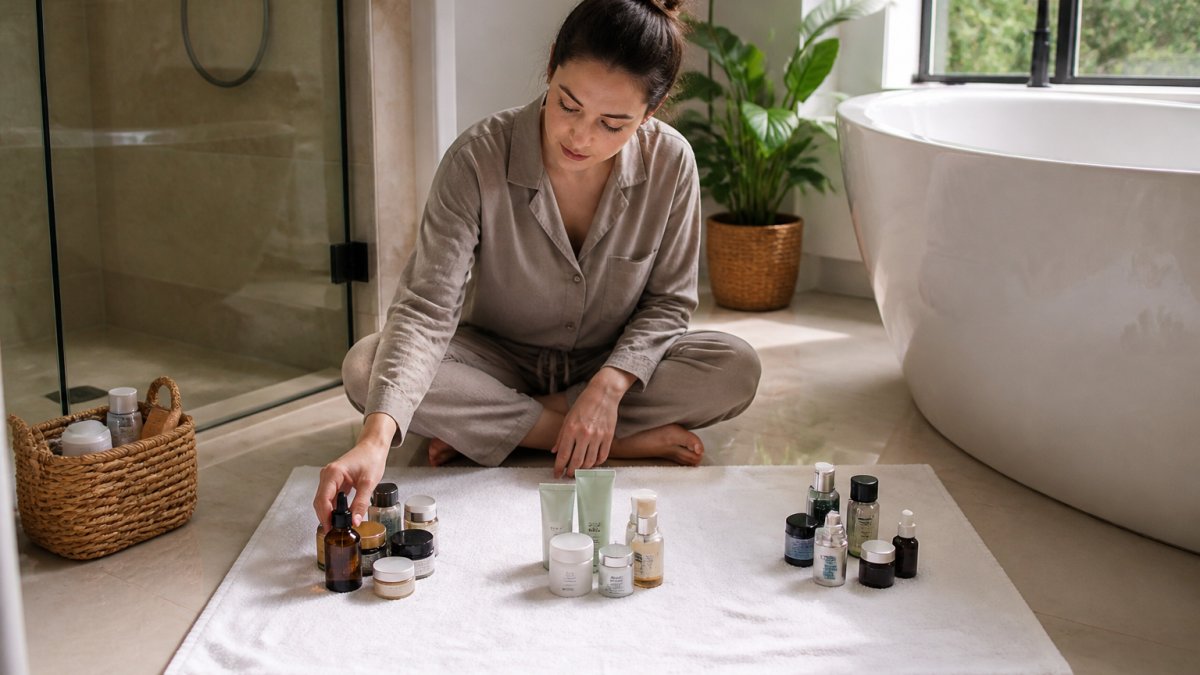
The "finish" pile is where most people get stuck. A common mistake is keeping products out of guilt. If it does not serve your skin or your goals, it does not belong in your routine.
A Practical Decision Framework for Every Product
Piles are a start, but the real work is deciding what each product is doing for you. Use these four questions on every item you are unsure about:
- Does it have a clear job? If you cannot say what concern it targets in one sentence, it is probably clutter.
- Does it overlap with something else? Two hydrating serums, three moisturizers, or four cleansers usually mean you can keep the one you reach for most.
- Does it conflict with anything? Some active ingredients do not pair well in the same routine. If you are layering strong exfoliating acids with retinoids, for example, you may be causing irritation without realizing it.
- Would you buy it again today? If the answer is no, it does not earn its place.
A simple way to sort the "keep" pile further is to label each product by role: cleanse, treat, hydrate, or protect. Most routines only need one or two products in each role. If a role has more than two, you have found your first cut.
What to Do With the Maybe Pile
Some products are not clearly keep or toss. For those, set them aside in a small box for two weeks. If you do not reach for them in that time, they go.
For products you are unsure about because of irritation, stop using them one at a time rather than all at once. Removing several products together makes it hard to know which one was the problem.
Once your audit is done, you should have a small keep pile, a short finish list, and a clear sense of what your routine actually needs. That is the foundation for the next step.
Step 2: Build a Minimalist Skincare Routine Around Three Essentials
A minimalist skincare routine rests on three products: a gentle cleanser, a moisturizer, and sunscreen. Add nothing else until these three are consistent.
This is the core of any simple skincare routine. Get these right before you spend on treatments.
Cleanse, Hydrate, Protect
Cleanse to remove dirt, oil, and makeup without stripping your skin barrier. A gentle cleanser works for most skin types.
Hydrate with a moisturizer that suits your skin. Dry skin needs richer creams. Oily skin does better with lightweight gels.
Protect with broad-spectrum sunscreen every morning. This is the single most effective anti-aging step you can take.
Three products. That is your foundation. Everything else is an optional add-on.
Step 3: A Simple Skincare Routine for Beginners (Morning and Evening)
A beginner routine should take under five minutes. Here is how to structure your day.
- Rinse with water or use a gentle cleanser
- Apply moisturizer
- Apply sunscreen (SPF 30 or higher)
Evening routine:
- Remove makeup and cleanse
- Apply moisturizer
- Add one treatment product if needed
That is it. No ten-step process. No waiting between layers.
If you wear makeup, an oil-based cleanser followed by a gentle cleanser removes everything. This is called double cleansing, and it works well for most people.
For beginners, resist the urge to add active ingredients like retinol or acids right away. Introduce one product at a time, every two weeks.
Step 4: Create a Beauty Routine Checklist You Will Actually Follow
A beauty routine checklist turns your intentions into habits. Keep it short and visible.
Write your routine on a card and stick it to your mirror. Check off each step for the first two weeks. After that, it becomes automatic.
Sample Daily and Weekly Checklist
| Frequency | Step | Time |
|---|---|---|
| Daily AM | Cleanse, moisturize, sunscreen | 3 min |
| Daily PM | Remove makeup, cleanse, moisturize | 4 min |
| Weekly | Exfoliate or use a face mask | 10 min |
| Monthly | Review products, replace empties | 15 min |
The monthly review keeps your routine clean. It stops clutter from creeping back in.
Step 5: Decide Whether At-Home Beauty Devices Earn Their Place
At-home beauty devices can add value, but only if you use them. A device that sits in a drawer is just expensive clutter.
Ask three questions before buying:
- Does it target a real concern? Buy for a specific goal, not curiosity.
- Will you use it weekly? Most devices need regular use to show results.
- Does it replace or add steps? The best devices replace several products.
A device earns its place when it replaces two or three products you already use. If it only adds a step, think hard before buying.
At Let's Elevate Enterprises LLC, we curate beauty tech with this filter in mind. Our deep-dive reports explain what each device does and who it suits.
Step 6: Simplify Makeup, Haircare, and Body Care Too
Skincare is only one part of the puzzle. Your makeup, haircare, and body care deserve the same edit. Most guides stop at facial skincare, but a beauty routine is broader than that, and simplifying only one category leaves clutter and decision fatigue in the others.
The same rule applies everywhere: quality over quantity. One product that works beats five that sit unused. Here is how to apply the audit mindset to each category.
Makeup: Build a Core Kit, Not a Collection
A simplified makeup routine starts with a small kit that covers your daily needs. For most people, that means:
- A base product (tinted moisturizer, skin tint, or foundation)
- A concealer for spots or under-eyes
- A brow product
- A mascara
- One or two lip products
- One blush or bronzer if you use it
Everything else, including eyeshadow palettes, highlighters, and setting sprays, is optional. If you have not used a product in the last month, it is a candidate for the maybe box.
A useful test is the five-minute face. If you can complete your makeup in five minutes with what you own, your kit is working. If it takes longer because you are choosing between products, you have too many.
Haircare: Match Products to Your Hair, Not to Trends
Most people need three things: a shampoo, a conditioner, and one styling product. That is the core. Everything else, including masks, oils, and heat protectants, is a targeted add-on.
Ask yourself what your hair actually needs. If it is dry, a weekly mask may help.
A common pattern is to keep one shampoo for regular use and one clarifying or treatment shampoo for occasional use.
Body Care: Keep It Basic and Consistent
Body care is the easiest category to simplify because the needs are straightforward:
- A gentle body wash
- A body moisturizer
- Sunscreen for exposed skin
If you have body acne, keratosis pilaris, or very dry skin, you may need one targeted product. But most people do not need a separate scrub, a body oil, a firming cream, and a fragrance layered on top. Pick the one that addresses your main concern and skip the rest.
The Cross-Category Rule
When you simplify across categories, watch for products that do the same job in different forms. A tinted moisturizer with SPF can replace foundation and sunscreen for some people.
The goal is not to strip your routine down to nothing. It is to remove the products that add steps without adding results. If a product earns its place by solving a real problem or replacing two others, keep it.
Once your makeup, haircare, and body care are edited down, your whole routine becomes easier to maintain. That is the point of simplifying: fewer decisions, better results, and a routine you can actually keep.
Step 7: Track Results and Adjust Without Irritation
Track your skin for four to six weeks before judging a routine.
Keep a simple log. Note how your skin feels, looks, and reacts.
If something irritates your skin, stop it. Do not push through.
When you add a new product, add one at a time.
Results timeline for most people:
- Week 1-2: skin adjusts, minor changes
- Week 3-4: early improvements in hydration
- Week 6+: clearer picture of what works
Consistency beats intensity. A simple routine done daily will outperform a complex one done twice a week.
Simplifying your beauty routine is not about doing less for its own sake.
Let's Elevate Enterprises LLC helps you make that call. We curate luxury lifestyle tools, offer deep-dive reports on beauty tech, and focus on intentional self-growth.
Frequently Asked Questions
What are the essential steps in a simple skincare routine?
Three steps cover the basics: cleanse, moisturize, and apply sunscreen in the morning. A gentle cleanser removes makeup, sebum, and daily buildup without stripping your skin barrier. Moisturizer restores hydration, and SPF protects against UV damage that drives premature aging. If you wear makeup or heavy sunscreen, add an oil-based cleanser first as part of double cleansing. Everything else, including serums, eye cream, and exfoliators, is an optional add-on you can introduce once the core three feel automatic.
How do I know which beauty products to keep or remove?
Sort everything into four piles: keep, finish, donate or bin, and decide later. Keep products you use at least weekly and that suit your skin type. Finish anything nearly empty before buying replacements. Bin anything expired, separated, or that caused irritation. For the decide-later pile, store it out of sight for a month. If you never reach for it, it goes. This product audit usually cuts a routine by half within one afternoon.
Can at-home beauty devices simplify a skincare routine?
Yes, when one device replaces several products or steps. A single well-chosen tool, such as an LED mask or a cleansing device, can reduce the number of serums and treatments you layer each week. The catch is consistency: devices only deliver results with regular use, so pick one that fits your available time. Buy from authorized retailers to confirm authenticity, and check that the device targets your main skin concern rather than adding another step you will skip.
How long should I wait before adding a new product to my routine?
Introduce one new product at a time and give it two to four weeks before judging results or adding anything else. This makes it easy to identify what caused a reaction if one appears. Start with two or three uses per week for active ingredients like retinol or exfoliating acids, then build up as your skin tolerates it. If you strip your routine back to the basics first, you get a clean baseline for testing anything new.